
Welcoming while wandering
The power of pancakes, encouragement, and invitation

Sherry Chidwick is one of my favorite writers on Substack. Her weekly newsletter, Nomadic Midlife, provides updates from her travels around the world. I look forward to reading it each week. Sherry and her husband Andy sold almost everything they own, and now travel the world—oftentimes overland in their big yellow rig affectionally known as Walter (full name, Walter Mitsubishi).
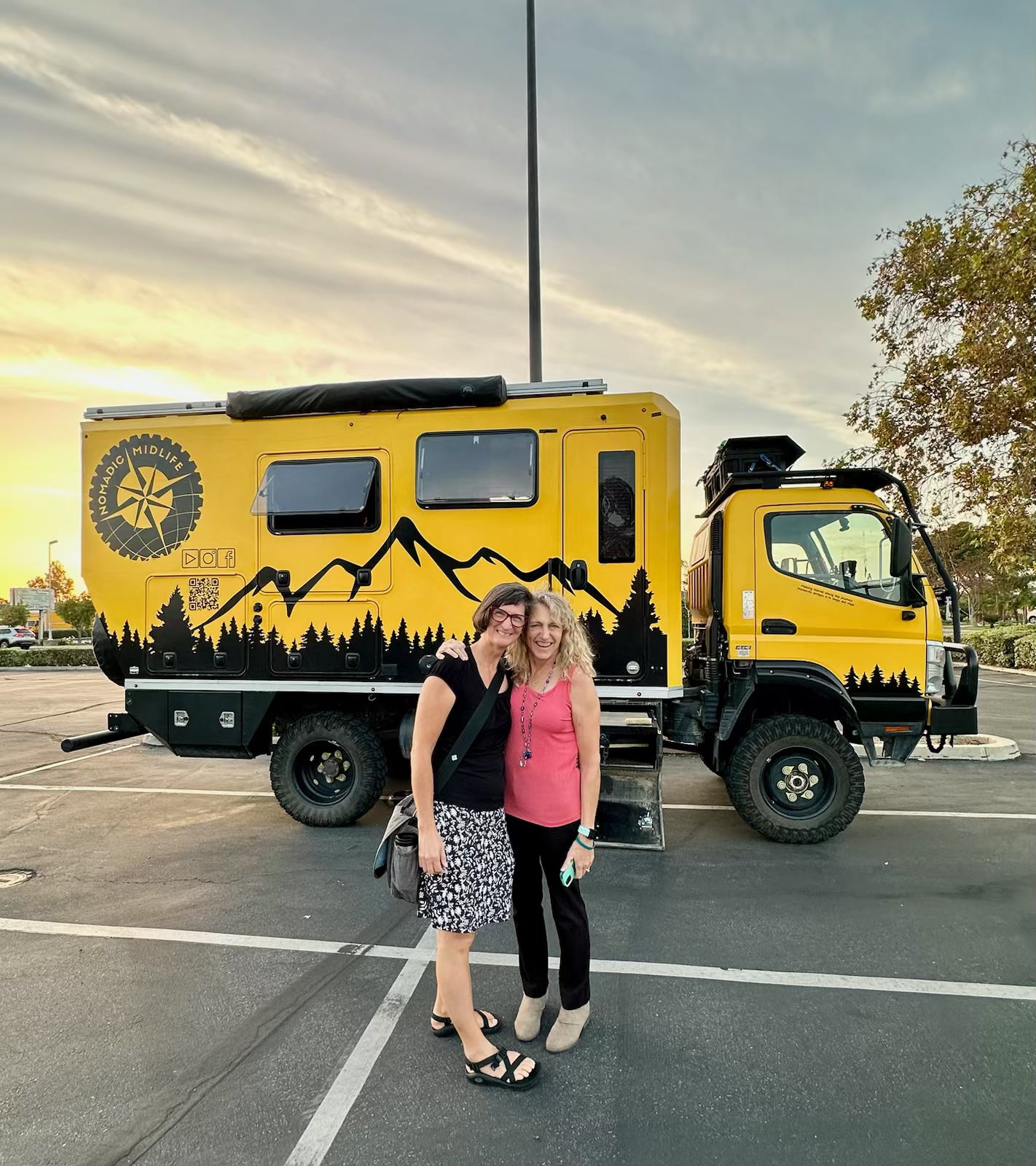
Sherry and I in front of Walter when we met in real life!
Right now she’s in Mexico on the Baja Penninsula (don’t worry, far from the recent cartel violence). She posted about her experience of camping on the beach (wandering) and inviting her neighbors to breakfast (welcoming). When I read it, I knew I had to share it with you. I know you’re going to love this. Enjoy. (Then go subscribe to her newsletter). Be sure to hit that like, share or comment button!
Google Maps can’t tell you how to find where we are currently living. Locals call it Playa El Puertito, but the map doesn’t name it, even if you zoom way in. You can search up the town nearest to us, the tiny fishing village of Agua Verde (population 210), but the only way to get between there and where we are—according to the online map, at least—is a one-minute scenic car ride through the gentle swells of the Sea of Cortez. I do not recommend this route.
From experience, I can tell you it is possible to make the trek on foot, a twenty-minute hike hugging the rocky coastline, but only attempt it at low tide. Otherwise, you’ll get stranded—or worse yet, washed out to sea. We’ve done the walk ourselves many times to pick up fresh tortillas and a few basic groceries, to treat ourselves to shrimp tacos at one of the two beach front seafood restaurants, and to get hot showers at the little thatch-roofed bath house so we don’t have to use our own precious drinking water for bathing. But if Google Maps can’t find a road to get this little beach, how did we?
We initially found this place last winter, at the recommendation of other overlanders. It’s actually quite legendary in the expat four-wheel drive community—free of charge, quiet, and idyllic. But there are no street signs or even significant landmarks in this part of the Baja Peninsula—just kilometer after kilometer of scrubby mesquite trees, lots of assorted cactus, sandy soil, and rock.
Last winter, finding Playa El Puertito was a trial-and-error process, sampling assorted dirt trails until we found the right one. This time, we just studied the satellite view and planned our route accordingly.
The road is rough, but passable for most vehicles with decent ground clearance. Getting down the final hill to the beach is exciting, but not terribly challenging. Gravity does much of the work. Climbing back up, however, is not for the faint of heart. A few days ago, we watched a front wheel drive van scramble halfway up and back down again four times before humbly requesting a tow up the deeply rutted and bouncy path from a more capable vehicle.
This place is absolutely magical, as good as we remember from last year. Out our passenger side windows, we gaze upon a tranquil cove—a sandy beach with a few sailboats moored long-term, just offshore. Out the driver side windows, the roar of the surf from the rough water crashing on the rocks lulls us to sleep each night. A cool breeze blows across the narrow spit each afternoon to moderate the blazing sun, leaving mornings for kayaking and evenings for campfires.
We are camped on the high ground in the middle, halfway between the two coastlines. Just like last time we were here, sunrise has become my new favorite time of day. I sit on Walter’s roof and sip my morning tea as I watch the pelicans dive, the gulls squawk, and the hawks and buzzards soar. Sometimes I even spot a whale spouting or a ray jumping.
Paying it forward
The magic of Playa El Puertito is not just in the scenery and the abundant wildlife. What we loved most about this place last year was the community that developed between all the campers. The people who make it to this remote, word-of-mouth beach are cut from a different cloth, it seems.
When we were here last year, though, we were part of a caravan. We brought established traveling companions with us. It’s no surprise, then, that we enjoyed campfires and nightly potluck dinners featuring the catch of the day. The others we met on the little beach were drawn to the fun and laughter we already shared, broadening the scope of our little community.
But this year, we came alone. If we want friends and the joy of fellowship, we have to be proactive.
Fortunately, we are still glowing from the hospitality we received in China, when a family we’d just met invited us to live with them for ten days—our own little informal cultural exchange program. That hospitality, which you can read about here, has grown inside us like a contagion.
When we stopped in Loreto over a week ago to get a full load of groceries before coming down here, I noticed a Costco-sized bag of Krusteaz pancake mix in the gringo section of the grocery store. Space for large items like that is at a premium in our little life, but I figured we could store it up in the cab if necessary. I had a plan.
One evening last week, I went around to the other vehicles on the beach by flashlight. “Heidy-ho, neighbor,” I called out each time, channeling my best Wilson from the 1990s sitcom, Home Improvement. I had to be loud enough for my voice to carry over the noise of the surf, but cheerful and chill enough to not startle anyone in the dark.
It was only an invitation to join us for pancakes, but you’d think I had just invited them for Christmas dinner. Everyone was so excited.
At one of the rigs, a sturdy Winnebago Class-C with all wheel drive so it can access places like this, I was invited inside. I met the couple, about our age, and we chatted a bit. A curly-coated dog was passed out between the driver and passenger seats, oblivious to my presence.
When I inquired about him, they informed me his name is Howie and he has assorted special needs, not the least of which is blindness. Howie sleeps soundly, they chuckled, since he has to concentrate so hard all day long to accommodate for his lack of sight. I was intrigued, looking forward to meeting him formally in the daylight.
The next morning at eight o’clock, twenty people from up and down the beach began to wander toward “our house” toward the far end. But they carried more than just their plates and forks and camp chairs. They brought platters of fresh papaya and strawberries and sliced bananas, extra butter and syrup, special homemade jam, even bacon. Thanks to the contributions of everyone, it was like stone soup.
(Remember the old European folktale about stone soup? I wrote about it here when we were in Thailand, two years ago. It’s one of my favorite posts ever.)
Our simple breakfast here on the beach in Baja grew into something spectacular. For two hours, we lingered, this rag-tag group of diverse folks (and several good dogs) from all over, ranging in age from less than a year to early 80s. We chatted and laughed, getting to know one another’s stories and enjoying conversation, mostly in English, with a wide variety of world accents. We talked about hospitality. We talked about paying kindnesses forward onto others. By the end, new friends were snapping photos and exchanging contact info.
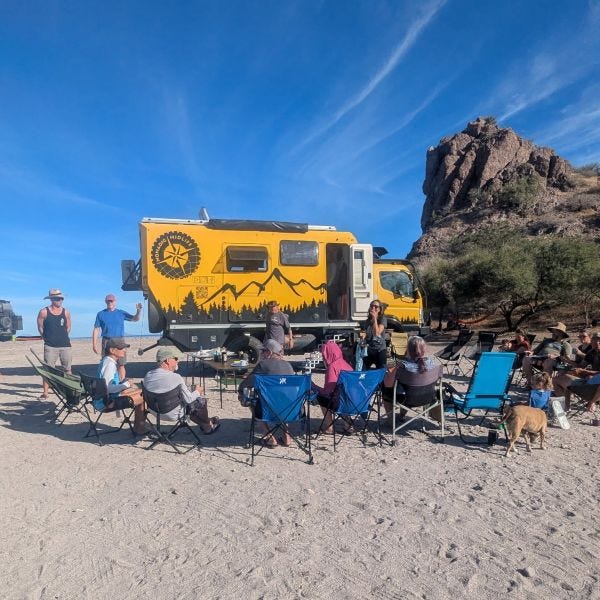
Within hours of our pancake breakfast, the little beach community took a more personal tone—a close-knit group of neighbors rather than a handful of considerate strangers trying to give each other space and privacy.
—
“Thanks for the breakfast. Would you like to use our kayak?”
“We would love that!”
—
“I experimented with no-churn homemade ice cream, and I think it turned out to be pretty good. Would you like to try some?”
“Oh, yes! And I might need that recipe.”
—
“We’re having a campfire tonight. Would you like to join us?”
“Sounds good. We’ll watch for the flames and bring our chairs down.”
—
“Do you happen to have an extra roll of toilet paper? We hadn’t realized we were almost out.”
“We have plenty. You can have three rolls if you’d like.”
—
“My daughter loved hanging out with you. She wanted to color a picture for you before we go.”
“I love it!”
—
I’m going out on my boat to try out some new lures, and I have room for one other person. Would you like to come along?”
“Absolutely!”
—
“Do you have an extra paperback book you don’t need? I’m down to one book I haven’t read yet, and I’m not enjoying it. I hate to be without anything to read.”
“I totally understand. Here are three options. Choose whichever one you want.”
—
“We’re leaving in the morning and have more fresh water than we need. We’d prefer to not carry the extra weight, but I hate to just dump it. Would you like to pump an extra ten gallons or so into your tank?”
“That would be great! Thanks!”
—
“I’m running over to the village market. Do you need anything?”
“No, I’m good, but thanks for asking.”
The human neighbors have been lovely. But back to Howie. Remember him? The curly-coated blind poodle mix?
I spent some time with this precious pup. His right eye socket is completely empty. You can see all the way into the deep pink hole that has long since healed over but still looks vulnerable and raw. His left eye is present but doesn’t work. When he is awake, Howie is in a constant state of alertness, head cocked, listening, learning about his environment primarily through his ears and the pads of his paws.
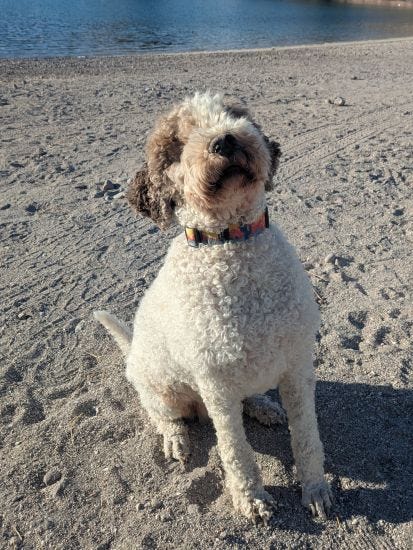
An outstanding listener, he follows his human parents’ voices, seeming to enjoy the “find me” game with the promise of a treat at the end of every round. As a travel dog, Howie spends much of his time away from home, away from the familiar arrangement of furniture and the layout of a secure backyard. Every few days, he has a new environment to learn. Regardless of the unfamiliar terrain, he loves to go hiking, even in the spiny desert, and knows the commands stop and go, forward and backward, over and under, among others.
Howie has no choice but to trust his humans will make sure his needs are met and will never steer him wrong. That kind of trust is built over time. It requires astounding levels of vulnerability and courage. We can learn a lot from a dog like Howie.
A few days after the breakfast event, one of the women I’d gotten to know over pancakes told me she and her husband were leaving early the next morning. Community is fleeting for us. Even though a new camper would likely take their place before long, I was sad to see her go.
When it looked like they had their vehicle all packed up and ready to roll, I climbed down from my sunrise rooftop perch to give my new friend a hug. She was already marching toward our truck by the time I stepped out our door and down the front steps.
“It was so good to meet you,” I said with a smile.
“And I’m so glad to have met you,” she replied as we hugged. Then, without missing a beat, she pulled back from the hug and looked me in the eye. “But I’m so afraid to go home.”
I looked at her face. She was fighting tears. My mind raced. Why was she afraid? Was this a domestic violence situation?
“Oh, honey,” I said first, pulling her into another hug while I thought through my options. “What are you afraid of?”
“It’s the hill. I’m afraid of climbing that hill. I’m so afraid, but I can’t let him see it. I can’t let him see me cry about this.” She reached behind her glasses to wipe at her eyes. “It’s silly. I should be brave. I’m trying not to cry, but I can’t help it. I’m really scared.”
My new friend was being vulnerable. She was exposing her weakness, trusting me to be gentle with her fear and help her find her footing. It was a Howie moment of trust, and I dared not squander it.
“Ok.” I released her from the hug but kept my hands on her shoulders, turning my own taller body to block any view her husband might have of her splotchy face. Quietly, I spoke with a firm, but kind voice, shooting for reassuring and hoping I was somewhere close. “You are going to be fine. Another rig just like yours left yesterday. Did you see them leave?”
She nodded, dabbing at the tears now leaking from her eyes.
“Theirs did fine. Yours will do fine, too. Your rig was built to be able to handle this.”
She nodded again, still dabbing.
“And if you guys need help, there are plenty of people here who can help.”
More nodding. Quick deep breaths to get control.
“I was scared the first time we climbed that hill, too. But your rig is capable. It’s gonna be ok.”
I did my best to steady her with my own confidence. I wiped my thumb at a tear that had escaped down her cheek.
“Ok,” she said. “Thank you. Ok.” She breathed.
“You got this.”
“Yeah. Thanks.”
“Absolutely.”
We exchanged one more hug, then she waved and walked off. They climbed the hill just fine. At the top, they both exited the vehicle and looked down at the little cheering section on the beach. For those of us left behind, the morning departures are widely considered to be must-see-TV, so everyone was out of their rigs to watch. All of us—top of the hill and bottom of the hill people—lifted our arms and cheered the victory.
My new friend hadn’t needed to borrow an egg or a cup of sugar or a roll of toilet paper. She needed to admit her fear to someone and borrow some of their courage. Who was I to deny a sister in need?
Hospitality. Kindness. Neighborliness. Trust.
Who knew these would be the lessons we’d learn on a remote beach in Baja?
The neighborhood turns over constantly here. Most people can only afford a few days in this little slice of paradise. We’ve already been here over a week, which in Playa El Puertito terms makes us old-timers, second only to Peter, a 78-year-old fellow-Montanan who’s been here since November.
Another short timer just offered us more extra water, as he is now packing up and likewise doesn’t want to haul any unnecessary weight up the hill.
We went around the beach again today and invited everyone for a pancake breakfast tomorrow. It’s a new crowd, and I look forward to the new connections we will make. Lacking built-in community, sometimes you just have to take things into your own hands. And like Howie, sometimes you have to trust the people around you.
Until next week,
Sherry
P.S. In case you are wondering, I actually am getting quite a bit of writing done on the novels I posted about a few weeks ago. The scenery is a bit distracting, but I’m still averaging 1000-2000 words each day. Just a few days ago, I was writing a very stressful scene about some boys in a boat when an unexpected storm came up—while simultaneously, in reality, Andy was out on the open (but calm) water in a tiny fishing boat for the day. Yikes. Bad combination. I actually had to fight my brain to keep from transferring the stress from the written page onto the reality of my situation. I was glad to get him safely back at the end of the day, that’s for sure. I won’t spoil the book for you by revealing the outcome of the fictional boys’ dangerous day on the water.
Also, last winter when we were here on this same beach, I wrote about my encounter with one of the boys from the little fishing village of Agua Verde. You can read about it here.
_______________
[Check out Sherry’s newsletter, Nomadic MidLife, for a thoughtful weekly read about our global adventures as minimalist, monogamous, midlife nomads. Her website is Her website is https://www.nomadicmidlife.com/
]

Love finding Sherry's work here!
Amazing what breaking bread - even pancakes- together can do for creating community! I love reading their life, also!